
The American Academy of Neurology (AAN) and American Headache Society (AHS) have published new 2026 recommendations for migraine prevention, based on a large systematic review of the available evidence. Here are the key changes in the migraine guidelines 2026 update that are most relevant for patients and caregivers.
When to start a preventive drug for migraine?
Basically, as some of you might know, there are acute drugs- given when you’re having a headache; and preventive drugs- which are given regularly to prevent these headaches from happening in the first place.
For patients with
- 4 or more migraine days/ month OR
- 4 or more moderate to severe headaches/month (note: not all of these need to be typical migraines) OR
- Substantial disability due to the headache
If any one of these is satisfied, your doctor should offer you a preventive treatment.
How preventive drugs are chosen?
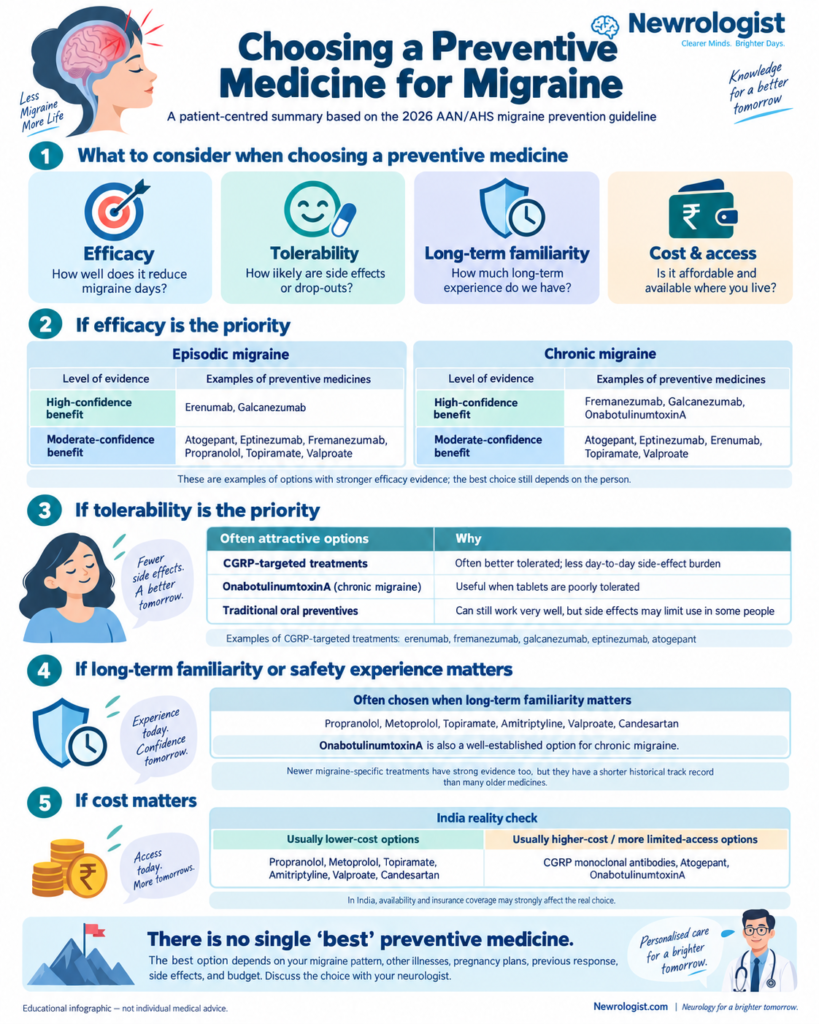
As you can see in the image, 4 points have been clearly mentioned to help decide on the best drug for a patient, which include
- Efficacy- how well the drug improves the migraine
- Tolerability- how easily a patient can tolerate the drug, which may be related to it’s side effects
- Long-term safety- in terms of known long-term side effects
- Cost
They have also mentioned which drugs should be offered based on what is most important to you, as a patient. Your doctor will discuss these points with you and based on your age, comorbidities, preferences etc, you can together decide which of these drugs is an ideal first option for you.
When do I know if my drug is working or not?!
I often come across patients who’ve tried even 6-8 migraine therapies!! and they say nothing works. When I take a detailed history, it becomes clear that they started with one drug- there was no improvement in a couple of weeks- They consulted a different doctor- A new medication was started and so on…
Please note that across a variety of trials of migraine therapies, in general the effect of the drugs starts usually around 8-12 weeks for most drugs. That too at the optimal dosage. Doctors often start drugs at lower doses and build them up to watch for or avoid side effects. It might take 2-4 weeks to build the drug up to an optimal dose. 8-12 weeks after that is when we can realistically assess whether the drug is working or not!
And what exactly does a drug working or not mean?!
In most cases a reduction of the headache days by 50% is considered significant. Or a significant reduction in the disability associated or the severity of the headache can also be considered on an individual basis. So most importantly for you as a patient – maintaining a headache diary and recording your headaches before and after treatment, as well as lifestyle changes, avoiding triggers etc which your doctor will discuss with you- is crucial to determine the actual success or failure of a treatment!
CGRP drugs upfront!
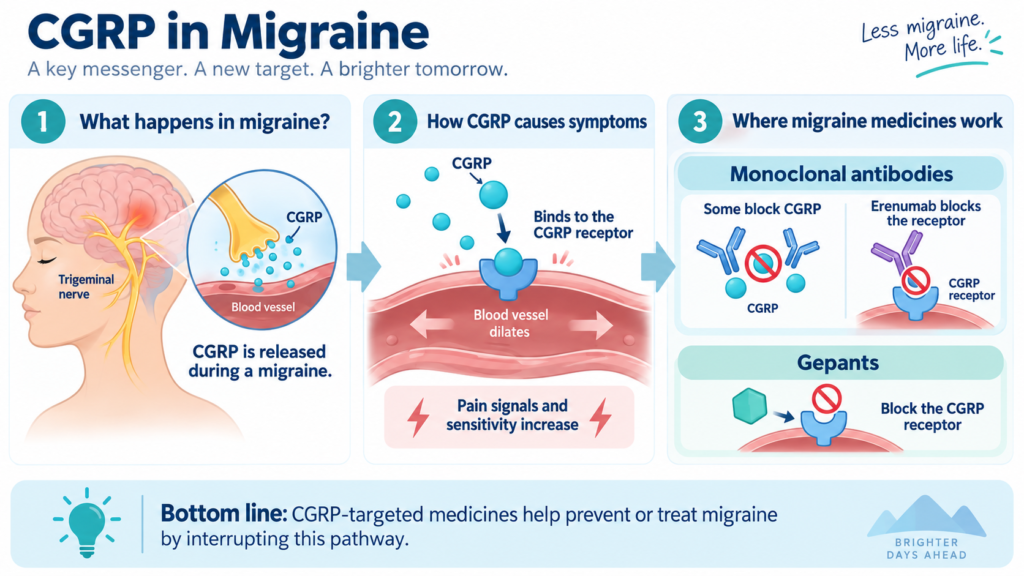
CGRP (Calcitonin gene regulated peptide) is an important chemical mediator in how migraine actually occurs. Drugs which act on this pathway have thus been studied extensively recently and used quite successfully in multiple clinical trials, showing moderate to high efficacy.
These were traditionally recommended after failure of 2 or more of the older migraine therapies. But as more and more evidence supporting these has accumulated, even in a 2024 Paper by the American Headache Society, they had mentioned that these can be one of the first-line options.
This has been reinforced in the current guidelines. As you can see in the graphic above, these have been mentioned as part of the first-line options.
Note of caution: These drugs are quite expensive and only some of these are available widely in India. Erenumab injections given once monthly cost around 20-25,000 Rs per month. Rimegepant which is approved for acute use (when headache occurs) in India costs around Rs.1500 per tablet.
So, although their recommendations have slightly changed, due to affordability, lack of insurance coverage amongst other reasons, these still might be one of the reserve drugs used when the traditional ones don’t work, especially in the Indian scenario.
Medication overuse migraine strategy!
Due to these headaches patients often overuse the acute treatments -which can lead to complex changes in the neurotransmitters in the brain. This can worsen the headaches.
In such patients, treatments involve a combination of stopping these drugs and starting preventive treatment for migraine. The guidelines have explicitly mentioned the drugs which have evidence in such cases- CGRP monoclonal antibodies, atogepant, botox, topiramate.
I’m Pregnant and have a severe migraine- what do I do?
Firstly, even women of childbearing potential should know that drugs such as valproate, topiramate are teratogenic and can affect the fetus early even in an unplanned pregnancy. It is important to discuss these with your doctor before starting a drug.
The guidelines recommend exhausting non-drug treatments such as behavioural therapy, acupuncture, exercise etc in pregnant patients before considering drugs. In cases where drugs are needed, there should be a detailed discussion of risks and benefits.
There is a recommendation that nifedipine, a drug with low level of evidence for migraine, may be given. This is mainly due to the fact that there is no evidence of increased fetal malformations due to this drug. Other options include propanolol, metoprolol, botox; however the risks and benefits need to be discussed in detail with your doctor.
I also have fibromyalgia along with a migraine!
In patients with the above combination, the guidelines recommend amitriptylline as an important drug which has evidence of efficacy in both these conditions and can be considered as a good option for treatment of such patients.
Please Note that there are a few more recommendations in these guidelines, and a lot of nuances related to each of them. Further, there are long-term studies conducted over years, which have led to these recommendations. We’ve only tried to highlight some of the important changes in this section. We can later come up with a more detailed version tailored to young doctors/ medical students.
Also please note that this article is for informational purposes and doesn’t intend to replace individualised care which every migraine patient needs- and can only be attained through a detailed assessment by your neurologist! (or Newrologist :p)
Dr Avinash Ganapule
Neurologist | DM Neurology, AIIMS New Delhi
I’m a neurologist interested in making reliable neurological information easier to understand for patients, caregivers and healthcare professionals.
References:
1.Potrebic S, Tanveer S, Becker WJ, et al. Pharmacologic Treatment for Migraine Prevention in Adults Practice Guideline Recommendations: Report of the AAN Guidelines Subcommittee and the American Headache Society. Neurology. 2026;107(7):e214881. doi:10.1212/WNL.0000000000214881.
2.Pringsheim T, Smith DB, Tanveer S, et al. Systematic Review of Pharmacologic Treatment for Migraine Prevention in Adults: Report of the AAN Guidelines Subcommittee and the American Headache Society. Neurology. 2026;107(7):e218112. doi:10.1212/WNL.0000000000218112.
Leave a Reply