What is a seizure?
“An epileptic seizure is a transient occurrence of signs and/or symptoms due to abnormal excessive or synchronous neuronal activity in the brain.” (1)
Transient meaning it has a clear start and an end.
Signs are what an observer sees- these could include the limb tightening or jerking that you see during a seizure classically.
Symptoms are what the patient experiences- some patients feel tightness in the abdomen before a seizure, or fear during an episode and so on.
Our brain normally works through highly organised electrical activity between billions of nerve cells (neurons). During an epileptic seizure, this electrical activity becomes abnormal. Neurons may become excessively active (“excessive activity”), or large groups of neurons may start firing together in an abnormally coordinated way (“abnormal synchrony”).
Depending on which brain networks are involved, this can produce very different signs or symptoms—from a brief unusual sensation or staring episode to stiffening, jerking and loss of consciousness.
Why do seizures occur?
So, why does this abnormal electrical activity occur in the brain?
Consider two scenarios, one where there is a temporary problem affecting the brain, say an infection or hypoglycaemia. Once the insult or problem is dealt with, the patient may not continue to have a risk of further seizures. These are often referred to as acute symptomatic seizures.
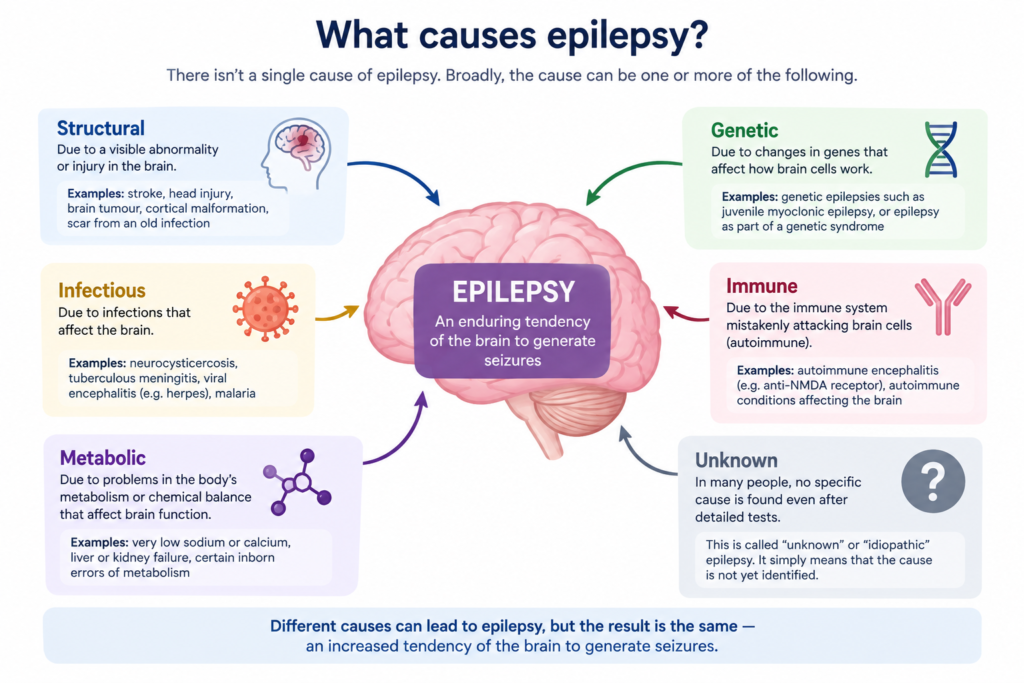
In the second scenario, the brain has a persistent tendency to develop seizures, even in the absence of such a temporary problem. This enduring tendency to have seizures is what forms the basis of epilepsy, which we’ll understand in the next section.
Does every seizure mean that I have epilepsy?
No
Epilepsy is a disorder of the brain characterized by an enduring predisposition to generate epileptic seizures (and by the neurobiologic, cognitive, psychological, and social consequences of this condition).
So a patient may only have an acute symptomatic seizure as we discussed; however they may not have epilepsy.
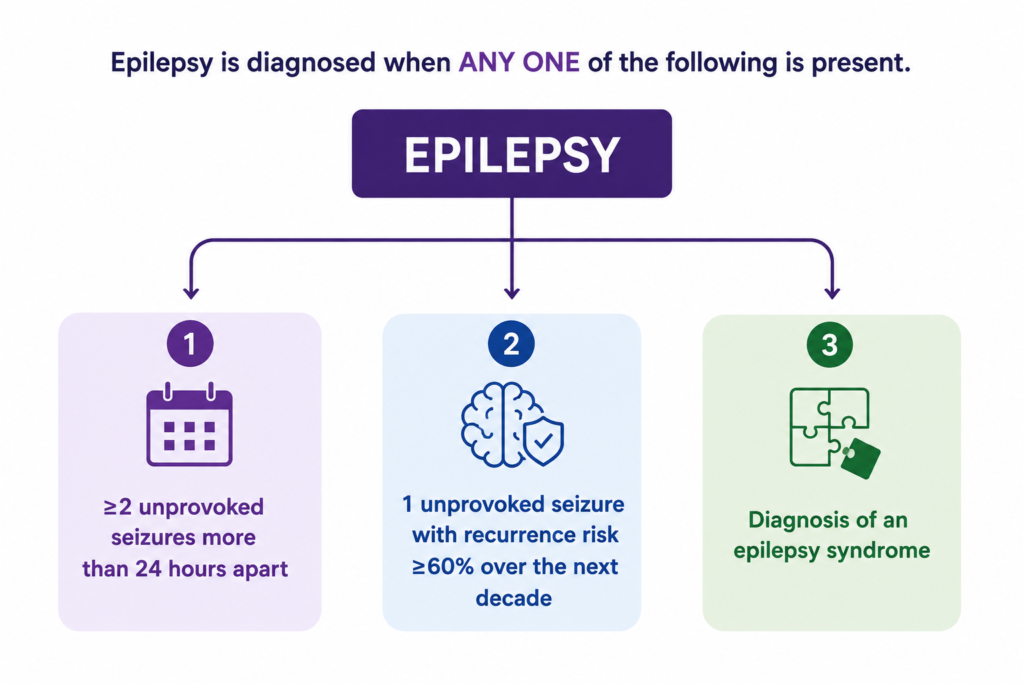
Epilepsy is defined by one of
- >=2 unprovoked seizures more than 24 hours apart
- 1 unprovoked seizure with recurrence risk >=60% over the next decade (similar to the general recurrence risk after 2 unprovoked seizures)
- Diagnosis of an epilepsy syndrome
So one of the ways in which epilepsy may be diagnosed is if there are two or more unprovoked seizures. The term ‘unprovoked’ eliminates the acute symptomatic seizures which occur due to an insult, that we discussed above.
The second way to diagnose epilepsy even in someone with a single unprovoked seizure is by way of risk estimation. Means such as EEG, MRI may be used by your neurologist, and if they show characteristic abnormalities, it may support a diagnosis of epilepsy.
The third is with a diagnosis of an epilepsy syndrome. A syndrome is a group of signs/symptoms which occur together. An epilepsy syndrome is a characteristic pattern of epilepsy in which features such as the age at which seizures begin, the types of seizures, EEG findings and sometimes imaging, genetic or other clinical features occur together in a recognisable pattern. The diagnosis of any of these syndromes also implies a diagnosis of epilepsy.
Does every seizure cause jerking or loss of consciousness?
Short answer — No.
You might have classically seen a patient having a seizure depicted in a movie or a series. What is usually shown is a seizure in which the person suddenly loses consciousness, falls down, becomes stiff and then develops jerking movements of the limbs. This is called a generalized tonic-clonic seizure.
However, not all seizures look like this.
Broadly, based on where they begin in the brain, seizures can be divided into focal and generalized seizures. Generalized seizures involve networks on both sides of the brain from the beginning, whereas focal seizures begin in a network on one side of the brain. A focal seizure may remain localized or subsequently spread to involve both sides of the brain.
As we discussed earlier, different areas and networks in our brain are responsible for different functions. Therefore, the symptoms produced during a focal seizure often depend on where the abnormal electrical activity begins and where it spreads.
For example, a focal seizure involving an area controlling movement may cause jerking or stiffening of one hand or limb, sometimes for only a short period, without the dramatic whole-body convulsion that people commonly associate with seizures.
Importantly, focal seizures can also have non-motor symptoms. A person may experience tingling or an unusual sensation in one part of the body, visual symptoms, an unusual smell or taste, a rising sensation in the abdomen, sudden fear or other unusual experiences.
In some of these seizures, the person may remain fully aware throughout. There may be very little for somebody watching them to notice—the seizure may primarily be something that the person themselves experiences.
So if seizures can look so different, what are the different types of seizures?
As we briefly touched upon earlier, seizures can broadly be classified based on where they begin in the brain. They may be focal, generalized, or unknown whether focal or generalized. Occasionally, there may not be enough information to classify a seizure, in which case it remains unclassified.
Generalized seizures involve networks on both sides of the brain from their onset. They include several different seizure types, one of which is the generalized tonic-clonic seizure that we discussed above, where a person typically loses consciousness, becomes stiff and subsequently develops jerking movements.
Another type is an absence seizure, seen more commonly in children. These may appear simply as very brief episodes of staring and unresponsiveness. Because they can be subtle and may occur repeatedly, they are sometimes mistaken for daydreaming and may interfere with a child’s performance at school.
Myoclonic seizures produce sudden, brief, jerk-like movements of one or more parts of the body. When they involve the arms, for example, a person may suddenly drop an object they are holding. In some epilepsy syndromes, particularly juvenile myoclonic epilepsy, these jerks characteristically occur after waking. There are several other types of generalized seizures, which we can discuss separately in subsequent articles.
Focal seizures, on the other hand, begin within a network on one side of the brain. What a person experiences—and what others observe—depends to a large extent on which brain networks are involved and how the seizure spreads. Focal seizures can therefore have motor symptoms such as jerking or stiffening, but they can also produce sensory, autonomic, cognitive or behavioural symptoms. Awareness may be preserved in some seizures and impaired in others.
Some examples help illustrate this. A seizure arising from the temporal lobe may produce an unusual rising sensation in the abdomen, a sudden feeling of fear or familiarity (déjà vu), or autonomic symptoms such as sweating or goosebumps. If networks responsible for awareness become involved, the person may become unresponsive and stare, sometimes accompanied by repetitive automatic movements.
Frontal lobe seizures are often brief and may occur predominantly during sleep. Some can produce unusual motor behaviours, including vigorous or apparently bizarre movements. Because of their appearance, these seizures can occasionally be mistaken for sleep disorders or non-epileptic events.
Seizures involving the occipital lobe, which processes vision, may produce visual symptoms such as flashes, coloured shapes or temporary loss of vision. More complex visual experiences can occur when the seizure spreads to other brain networks. Parietal lobe seizures can produce sensory experiences such as tingling, altered sensation or unusual perceptions involving different parts of the body.
These examples are not rigid rules. Seizures can spread rapidly from their site of onset to other brain regions, so the symptoms experienced by an individual may reflect several different networks.
Leave a Reply